FRACTURES AMID GLOBAL FLOODS AND MARKETS
A convergence of urban unrest in Europe, spikes in geopolitical tension, and climate-driven humanitarian shocks could produce cascading economic and information disruptions within the coming week. Financial markets and logistics corridors may react sharply if protests intensify or if conflict and weather-related supply interruptions deepen.
The Prophecy
A convergence of urban unrest in Europe, spikes in geopolitical tension, and climate-driven humanitarian shocks could produce cascading economic and information disruptions within the coming week. Financial markets and logistics corridors may react sharply if protests intensify or if conflict and weather-related supply interruptions deepen.
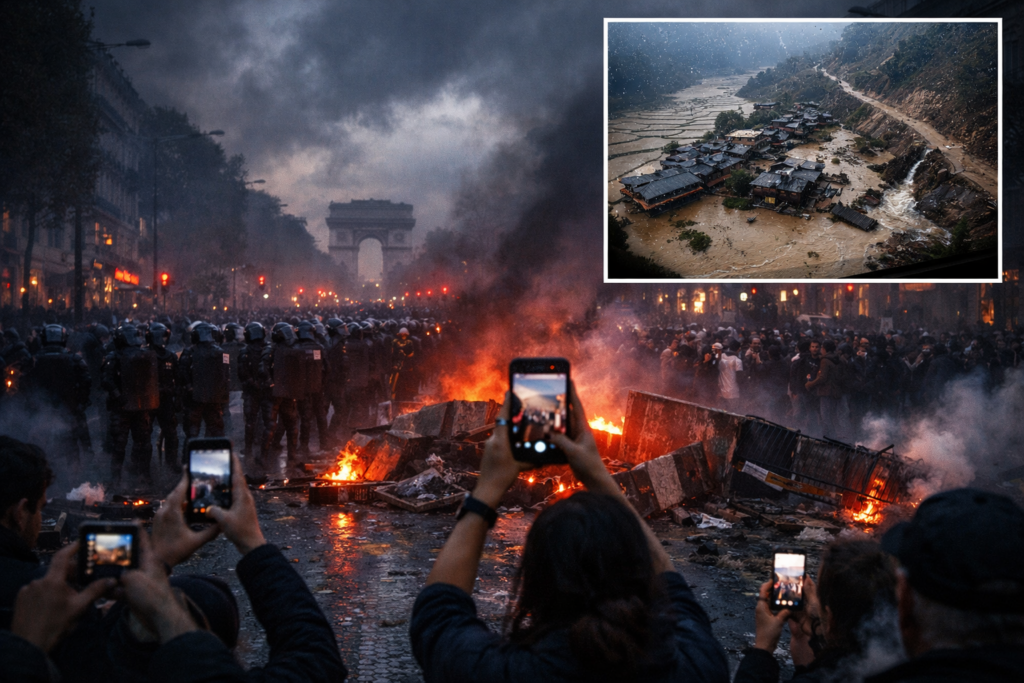
Over the next 3-7 days, localized shocks are likely to propagate into visible operational disruptions if current trends continue. Domestic instability in France — captured by headlines such as “France protests live: Macron admits ‘failures’ after days of violent unrest” — combined with social-media friction like “Outrage after Meta suspends No Kings Instagram account during protests,” could produce coordinated protest flashpoints and amplified online mobilisation. This may lead to temporary transport closures in major French cities, targeted strikes, and headline-driven volatility in European risk appetite.
Concurrently, geopolitical pressure around Ukraine and Gaza may push energy and defense-sensitive instruments higher and further destabilize sentiment. Diplomatic dynamics described by “Zelensky holds US talks as Trump accuses him of not wanting peace” and humanitarian warnings including “‘Life is absolutely brutal in Gaza,’ says World Food Programme head” could prompt rapid shifts in sanctions posture, aid flows, or naval/air deployments that feed into shorter-term commodity and logistics stress. Markets already jittery from the tech sell-off — “Tech market sell-off deepens amid fears over US inflation and AI debt” — may amplify these moves, producing outsized daily swings in equities and FX if a new shock arrives.
On the supply-chain and infrastructure side, climate and regional production signals add fragility. “Flash floods destroy villages in central Nepal” highlights near-term transport and agricultural interruption in South Asia, while China’s macro readout, “Strong Exports Stabilize China’s Economic Growth in Official Statistics,” suggests export corridors remain crucial and may temporarily shore up goods flows even as localized weather damage degrades upstream inputs. If flood damage delays shipments or prompts humanitarian reallocation of transport capacity, expect knock-on effects for seasonal manufacturing and inventory replenishment that disproportionately affect electronics and intermediate goods.
In this window, expect three measurable outcomes: 1) episodic urban disruptions in France that could force transit shutdowns and spur online protest campaigns, 2) increased short-term volatility in tech and commodity markets tied to geopolitical headlines and the existing sell-off, and 3) localized supply-chain interruptions in South Asia that may raise prices or delivery times for specific goods. Authorities, logistics operators, and risk teams should prioritize contingency routing, heightened media-monitoring, and rapid humanitarian-liaison options for the coming week.
Key Factors Driving This Prophecy
Source Headlines Analyzed
Risk Categories
Multiple independently reported developments combine near-term catalysts: sustained street protests in France and platform moderation disputes create a credible path to rapid escalation; contemporaneous geopolitical diplomacy and humanitarian crisis reporting increase the odds of market- and logistics-sensitive reactions; and climate-driven flood damage in Nepal adds localized supply-chain stress. Corroboration across distinct domains raises conditional confidence without implying certainty.
Regions Most At Risk
Pattern-based speculative forecast, not certainty.